gaetano-armenio-blog.webp

BLOG

contenuto-img1

4 March 2026

1996-2026. Thirty years of music, identity and shared passion.

There's one photograph in the exhibition that stopped me more than the others. A girl with her eyes closed, the clarinet resting against her forehead. No audience, no procession, no uniform in the foreground. Just concentration.

I built and shot that photo myself. I had many musicians in front of me, and I chose her. For her face, for the delicacy of the expression, but above all because she captures the environment I found when I joined the Associazione Musicale Santa Cecilia: surprisingly young. In that moment I also understood how to tell these thirty years. Not with a sequence of photographs, but with a story.


Designing a cultural event: turning memory into narrative

For me, designing cultural events is exactly this: turning images, memory and people into a story that can speak to a community. It's the work I've done for over forty-five years, across graphic design, publishing, photography and visual identity. And it's probably also the reason I was asked to coordinate this photographic exhibition.

The "best of youth" is not a slogan. They are the boys and girls who come to the association every day. The ones who study, rehearse, get it wrong, try again. The ones who choose to give their time to something that isn't only performance, but belonging.


On 22 April 1996, fifteen people decided Molfetta deserved a musical voice of its own. Since then that choice has become a path, a school, a discipline, a community. When I started working on the exhibition I understood right away that celebrating an anniversary wasn't enough. I had to give back the meaning of what this band represents for the city. So the exhibition runs through thirty years like a family album: from the founders to today's young players, from rehearsals to processions, from patron saint feasts to summer evenings.


A confession

While selecting the images, I felt a touch of envy. Not for the thirty years of history. For that quiet determination I see in their eyes. For the ability to stand inside a tradition without carrying it as a weight, but as a privilege.


A band that grows from below

The Banda Santa Cecilia is not only the soundtrack of Holy Week, the patron saint feast or Christmas among the alleys. It's a place of growth. A school of collective responsibility. A training ground in listening to one another.

The exhibition stays at the Sala dei Templari, in Molfetta, until 9 April 2026. That girl with the clarinet is there, among the others. Her eyes still closed.


contenuto-img1

9 February 2026

A Cardboard Suitcase to Tell the Story of the Enterprise. At a public meeting held in Molfetta, my city, I bring a cardboard suitcase instead of slides: inside, forty-five years of business told through images, memories and the choice to stay.


Hand luggage

When I was invited to speak at a public meeting organised by several civic movements in Molfetta on the value of enterprise, the first thing I did was to discard the idea of a written report. I could have done it. Neat slides, data, graphs. All correct. All useless. I would have been the first to get bored. So I took a cardboard suitcase. The old, ivory-coloured one that I have been carrying around with me for years. Not as a metaphor: just a suitcase. I filled it with images and went on stage in front of a packed hall. Without any notes to read. Freewheeling.


The suitcase doesn't lie

I began by saying that suitcase wasn't about the past. It was about a choice. The same choice that, in these parts, sooner or later everyone faces: to leave or to stay. Inside that suitcase was my beginning. Eighteen years old, a diploma, no job. A group of young people who, instead of waiting, decided to invent one. No business plan, no sophisticated strategy. Just the urgency to do something, here. We didn't know what to expect. And that's probably why we had the courage to start. Years of work, mistakes, adjustments, doors closing and others suddenly opening.


I have described what it really means to stay: making mistakes on your doorstep, meeting the same looks even when you fail, not being able to leave when things get complicated. Staying is not a pose. It is a continuous exposure. The room listened in silence. I spoke about territory, identity, responsibility. About entrepreneurship as a concrete alternative to resignation. Not as a promise, but as a possibility.


Value is demonstrated, not explained.

The next day, the messages arrived. Someone wrote: 'Genius and recklessness that conveyed the spirit of the entrepreneur.' I smiled. Because there was no genius. There was only a suitcase full of memories and the choice not to filter them. That evening, I realised something simple: the value of a business cannot be explained. It must be demonstrated. You don't need perfect slides. You need real objects, moments you can touch with your eyes.


You need the courage to open a suitcase and say: this is what we were, this is what we have become, with all the imperfections of the journey. Because, ultimately, this is what doing business is all about: not offering certainties, but demonstrating that choice is still possible.


Even if the choice is to stay.

contenuto-img1

5 February 2026

The Customer Always Calls Twice. Customer crisis management in packaging: how a mistake during an inauguration turned into a 30-year partnership. A true story of customer care that works.

When the error comes at the wrong time

1990 - "Gaetano, Dr Milo called: the labels are coming off the bottles." Francesca rushed into the Sala dei Templari in Molfetta just as I was shaking hands with the mayor in front of a painting from the Brera Academy. It was our moment of glory: a contemporary art exhibition, a newly opened office in Milan, the leap into art publishing. And then there it was, reality reminding you who you really are: someone who prints labels. A blow to the heart.

Managing the crisis while everyone is watching you

While I smiled at the authorities and pretended to listen to the opening speeches, my mind was already elsewhere. Financial damage for the client. Damage for us. Reputation at risk. And that nagging little voice whispering: "You don't know where to turn, do you?" But you already understand that at that moment you have to find the strength. You have to convince yourself before you convince the client that a solution exists, even if you can't see it at the moment. It's like bluffing in poker, except that here you can't afford to lose.


The only customer care rule that really matters

The next day, I went to Dr Milo without any defences or pre-prepared excuses. No buck-passing, no 'it's the supplier's fault', no beating about the bush. Just: 'This is what happened, it's our responsibility, this is the solution.' Because, you see, you can tell them all about your production chains, but for the customer, you are the company. You and only you. And if at that moment you try to hide behind technicalities or blame others, you have already lost everything.


From door to door to the pasta factory that plays rock music

He was one of the first customers we acquired outside Molfetta. We needed to grow, broaden our horizons, and step outside our comfort zone. And so began my very own door-to-door tour of the province. Frustration mixed with determination. Until that oil mill in Palombaio 'fell into the net', as I say. Today, Dr Milo is ninety years old. The oil mill has become an agri-food giant, thanks in part to the second generation. Giovanni, Saverio, Marida and Giuseppe, the latter a passionate U2 rocker with his own cover band. They have the same authenticity and courage as their father. They produce pasta and baked goods that they ship all over the world. And me? I feel a bit like family.


Over thirty years of partnership: when mistakes build trust

Since 1990, after that ill-fated phone call, I am still here. Not because we have never made mistakes again, but because when they happened, we faced up to them. Sincerity, respect, mutual trust. These are not corporate mission slogans; they are the only thing that keeps real relationships going. Labels still come off sometimes, metaphorically speaking. But when that happens, I know exactly what to do: introduce myself, look them in the eye, and resolve the issue. And thank Francesca, who ruined my opening day. It was the day I truly understood what it means to run a business.

Do you work with clients who deserve the same commitment as Dr Milo?

If you are looking for a packaging partner who shows up when things go wrong (not just when everything is going well), let's talk.

PS: above, the Milo family – photo by the yello agency – Bari

contenuto-img1

21 January 2026

"The Caravan of the Invisibles" Milan, late 1970s.


From Molfetta to the Navigli

On one side the neo-fascists were planting bombs on trains and in the squares (that summer of 1980, the Bologna massacre), on the other the Red Brigades shooting and killing. And us in the middle. The country seemed to be sinking into a creeping civil war, but in those days we had one fixed idea and a dream to make real: find the money to open the Cooperativa L'Immagine. No graduation-trip reward after the state exams.

From Molfetta we headed straight for that Milan, capital of work, of aperitifs and of the first baton blows. We arrived with empty pockets and heads full of dreams. Up at dawn, then down toward the Navigli, not the elegant ones of today but the rough ones, full of smoke and crumpled lives. In a crowded room we waited for the phone to ring: junkies, ex-cons, and us.


The Caravan of the Invisibles

Running the whole thing was the "Boss," a retired officer: a notebook, a telephone and absolute power. The companies would call, he would listen, hang up, throw a quick glance at the desperate humanity in front of him and decide who to hand the work to. Then he'd pass you a slip with an address, a time, the days. All strictly off the books. And then one day, among the many humiliations, there was the one where the "Boss" puts his hand between your thighs. Bastard. I said nothing.


What could I say? I was "the caravan guy," the southern immigrant, the nobody. We were part of the "caravan," a kind of temp agency before its time. We got the worst jobs. In the companies they recognised us at once: "They're the caravan lot." Mistrust, little jibes, suspicion. We were the "southerners in Milan," the "immigrants" of the day.


The Milanese Nights

But in the evening Milan changed its face. From the stinking Navigli to the smoky social centres, then the concerts of Talking Heads, Television, Ramones, the first baton charges seen up close. I had traded daytime exploitation for nighttime cultural education, and that, at least, I liked.


The Return Ticket

We went back to Molfetta one at a time, but not as beaten men. We were different: we knew what an hour of work was worth, what a dream costs, how heavily Milan weighs on the shoulders of those who won't give up. I had learned that shitty jobs don't diminish you, they train you for endurance. That every shift was one more brick for the cooperative. That leaving doesn't betray your roots: it strengthens them. And that when I had power, I would never use it the way the Boss did.


That company, born with the caravan's money, turns 45 this year. It has survived everything: crises, digital transformations, pandemics. It taught me that you don't need to set off with everything: you just need to set off. Today I still connect people, territories and projects across Apulia, Spain, Romania and Portugal.


contenuto-img1

12 January 2026

Learn the art: behind the mask there is a profession waiting for you

From hooded faces to masks of Europe

When I began documenting the rituals of Holy Week in Apulia years ago, the first thing that struck me was not just the statues or the processions. It was the hidden faces. The hooded brothers, with their white robes and hoods that transform people into symbols. Faces erased to become something else: penance, devotion, community. A sacred masquerade that functions exactly like the profane ones of ancient carnivals. When Europe chose us as communication coordinators for MASKS in 2024, I realised that I was coming full circle.

Twelve partners from Italy, Spain, Portugal and Romania, universities, museums and research centres, all focused on zooform masks: the ones you see at patron saint festivals and carnivals, which seem eternal but which someone has to continue to make, wear and pass on.


Why do we wear masks?

I have often asked myself this question while photographing rituals and festivals. The most honest answer I have found is this: people wear masks to stop being themselves. Not to hide, but to free yourself. From your name, your social role, judgement. The mask allows you to say, do and be what you normally couldn't. In sacred rites, you become a symbol: you are no longer Mario or Giuseppe, you are Penance incarnate. In ancient carnivals, rebellion takes centre stage: the poor become kings, the powerful are mocked, and rules are suspended for a day.


But there is also a sense of belonging: when you wear that mask, you become part of a community, part of a story greater than yourself. You are not alone, you are 'us'. That is why the European project MASKS is not a project about folklore. It is a project about what happens when you choose to become something else.


What you learn with MASKS

If you are a student, MASKS takes you inside the artisan workshops where the masks are created: it is design and engineering, anthropology and entrepreneurship, all rolled into one. MASKS is not an advanced course for experts. It is an opportunity to become one alongside Italian, Spanish, Portuguese and Romanian artisans. In our courses, we delve into the history and meaning of masks, explore materials and techniques with artisans, learn to recount rituals and festivals using contemporary language, and design itineraries, events and tourist experiences.


Above all, we build relationships: a European network of people who share the same passion.

There are twelve European partners waiting for you, including universities, museums, training centres and artisans.

contenuto-img1

31st December 2025

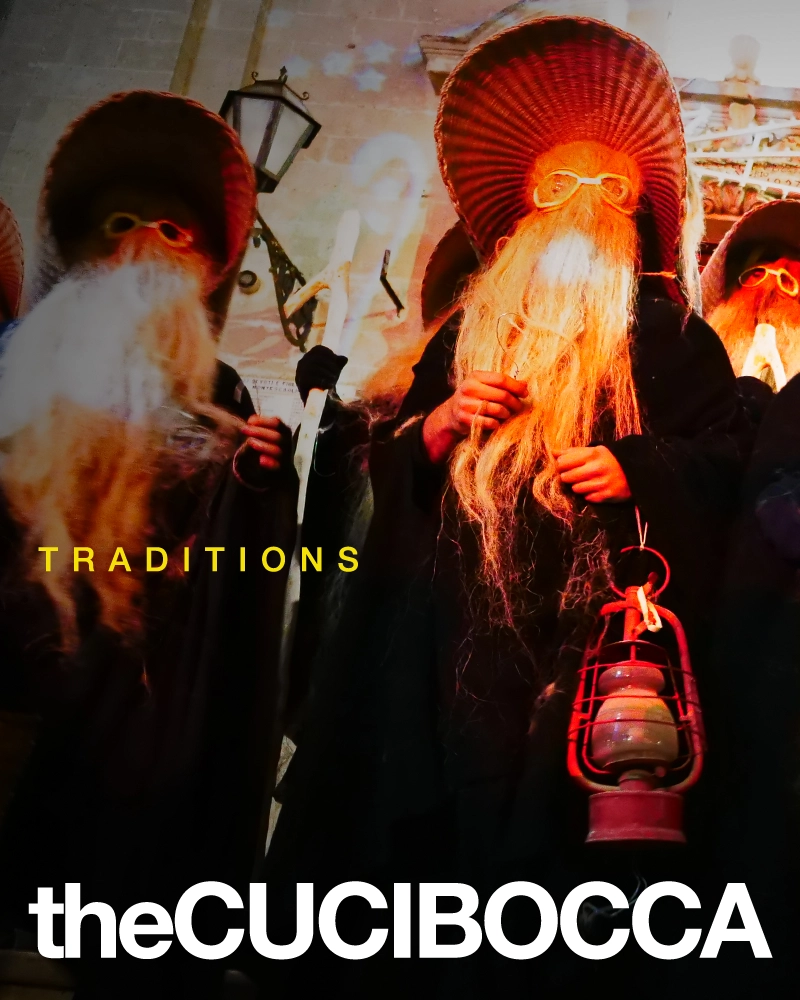
The Cucibocca of Montescaglioso: when anthropological masks look you in the eye. The Cucibocca of Montescaglioso (Matera): among the oldest anthropological masks in Italy. Discover the January 5 rite, intangible heritage of Basilicata.


Anthropological masks in Basilicata: a heritage to discover

Anthropological masks were a world I didn't know. Then I found myself handling the communication for MASKS – unveiling the arts and works behind the masks, a European Erasmus+ project involving Spain, Portugal, Romania and Italy to reveal the secrets of zoomorphic masks. And that's how I discovered that Basilicata transforms in January. Eight towns in the region, Tricarico, Satriano, San Mauro Forte, Aliano, Cirigliano, Teana, Lavello and Montescaglioso, guard an intangible cultural heritage recognised by the Region: ancestral masks that tell of rites thousands of years old.

The night of January 5: when silence becomes rite

The evening before Epiphany, Montescaglioso stops being an ordinary town. Black figures emerge from the Benedictine Abbey of San Michele Arcangelo. Dark cloaks, white beards of stinking hemp, unsettling glasses made from orange peel shaped to see through. On their heads, a fiscolo: that hemp disc used in oil mills to press olives, always dirty and foul-smelling. In their hands they carry a dim lantern, a wicker basket to collect offerings, and above all a long, menacing needle. At their ankle, a broken chain that drags across the cobblestones producing a ghostly sound.


Cucibocca: the layered symbolism of a complex rite

In the Lucanian tradition, the Cucibocca are the souls of Purgatory returning the night before Epiphany, looking for the houses where they once lived. They ask for food and water to put out the purifying flames. But every element tells overlapping stories. The broken chain recalls Saint Simeon Stylites (celebrated on January 5 in the Byzantine calendar) and also represents the symbolic liberation of peasants from their master's bondage.


The beard of stinking hemp is the anti-Santa Claus: he brings no gifts, he asks for them. The fiscolo on the head speaks of the world of the oil mills, of hard labour, of the land. The orange-peel glasses, a brilliant detail, turn the human gaze into something other.


"I'll sew your mouth shut": the rite of silence

"Ti còs' a vòcch!", I'll sew your mouth shut, he repeats brandishing the needle. It is the passage from the abundance of the Christmas "nine bites" to the Lenten fast. It is the silence imposed on humans because that night, according to legend, the animals regain their voice. The children? Drawn in but terrified. They hide behind their parents while these figures roam the misty alleys brandishing the needle. It is an ancient game between fear and delight: the Cucibocca threaten, the little ones run, the air fills with theatrical tension. This is living anthropology, and it is an experience to live.

Visit Montescaglioso on January 5 to experience the rite of the Cucibocca.


> discover the MASKS project