MASKS EUROPEAN PROJECT

MASKS EUROPEAN PROJECT

Home > Blog > MASKS EUROPEAN PROJECT

View Gallery

Discover more

STARTING ...

Bucharest 16/18 November 2026

I don't quite know how to make sense of my last night in Bucharest, when at three in the morning an earthquake jolted me out of bed and, out of sheer survival instinct, sent me running alone like a madman down the stairs towards the hotel exit while everyone else slept peacefully.

Out of breath, I slumped into an armchair in the reception, waiting for the anxiety to pass, and thought back over the two days that had just ended.


Bucharest looks east

I thought about the city too. Bucharest struck me as austere, like many places of the former communist bloc: huge old concrete blocks alternating with gleaming Western-style buildings, a melancholic air typical of Eastern countries, and lots of young people out in the streets. But it was at the table that I understood it looks more to the east than to the west: the flavours are those of Eastern cuisine.


And then there is Uber, which works perfectly there: you open the app and the car arrives. Back home, in many Italian cities, calling an Uber is still science fiction.


Three years of MASKS and a 3.9 in communication

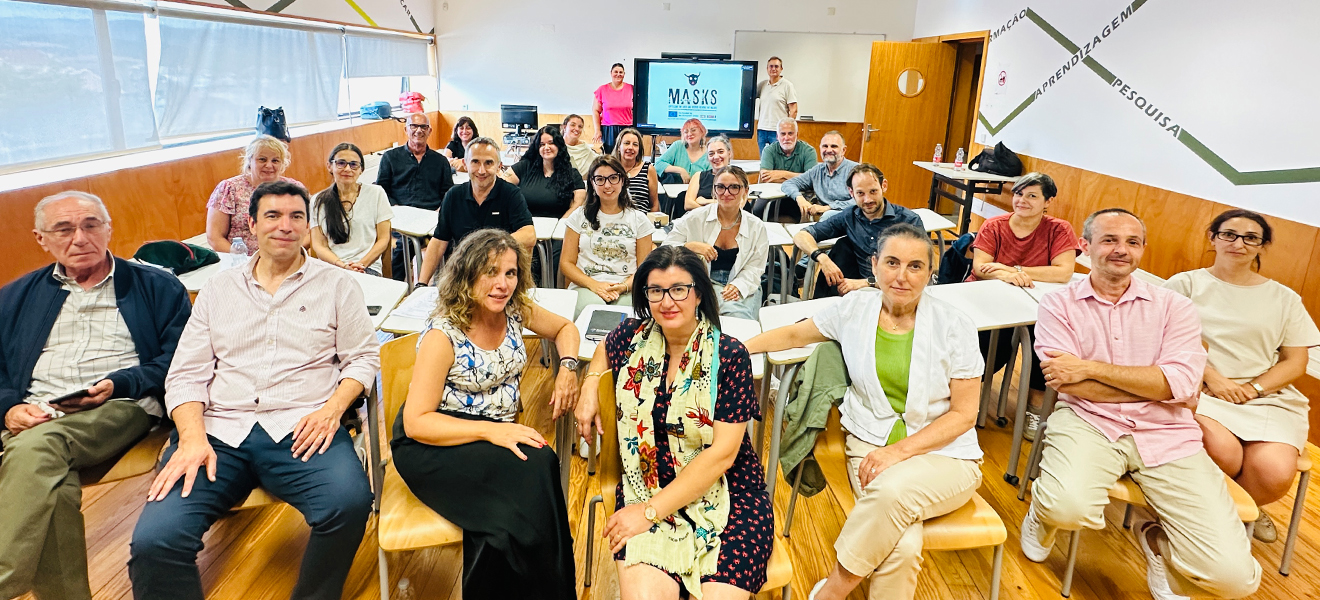
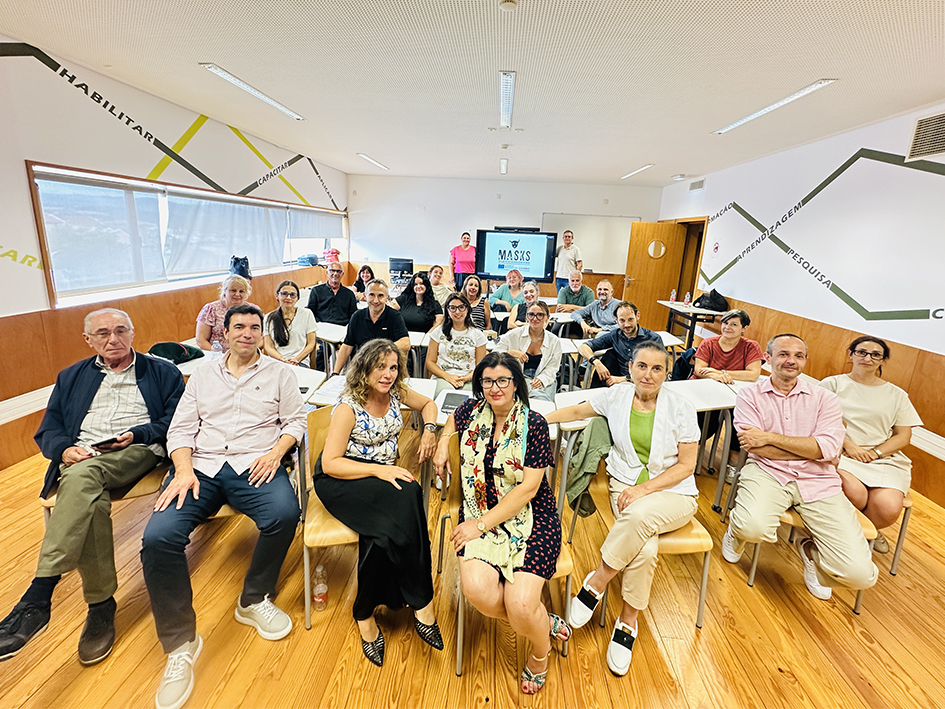
We were there for the final meeting of MASKS, Unveiling the arts and works behind the masks: three years of work and twelve partners across Italy, Spain, Portugal and Romania, focused on traditional masks and the people who make them.


The University of Valladolid in Spain, the University of Basilicata with the regional CNA, the University of Bucharest with the National Museum of the Romanian Peasant and the Folklore Archive of the Romanian Academy, the Portuguese training centres Cearte and Brigantia Ecopark, the Spanish Cearcal and Academia Ibérica de la Máscara, the Madrid agency Idimás and us, as Editrice L'Immagine.


The project's external evaluators, on a scale from 0 to 4, gave the communication work a 3.9. Good, in fact excellent. Pity that the person in charge of it, that is me, speaks broken English. And yet with the Spanish, the Portuguese and the Romanians we understood each other perfectly.

I wondered how.


Broken English at the Casa Universitarilor

The answer lay in the afternoon before. In the auditorium of the Casa Universitarilor I took the floor and, in my broken English, with Marica Petruzzella (who worked with me on this project) correcting me as I went, I confessed that I was on the verge of tears in front of them. It was the last time we would all be together.


Getting to know them and working with them over these three years had filled me with joy, both professionally and personally.

"Pass an emotion on to the person in front of you and they will follow you anywhere."


Painted hands and faces

So I asked them the thing that worried me most: to let me paint their hands and faces with the colours and tribal signs of the MASKS logo, for an improvised photo shoot. I thought they would back out; instead they all joined in, in an atmosphere of laughter and collective play, which was exactly what I wanted.


Starting over from three

At the end they told me they will involve us in the next European project. They told me there and then, in the heat of the moment, and I am holding on to it.

I believe communication is also made of posture, facial expressions and gestures, of how you present yourself to others. That afternoon before, I opened up first, and then I asked them to let themselves be painted.


The tremor passed. So did the anxiety. The cigarettes were still missing.

This morning we were at the airport, heading home.


For more, read the project card

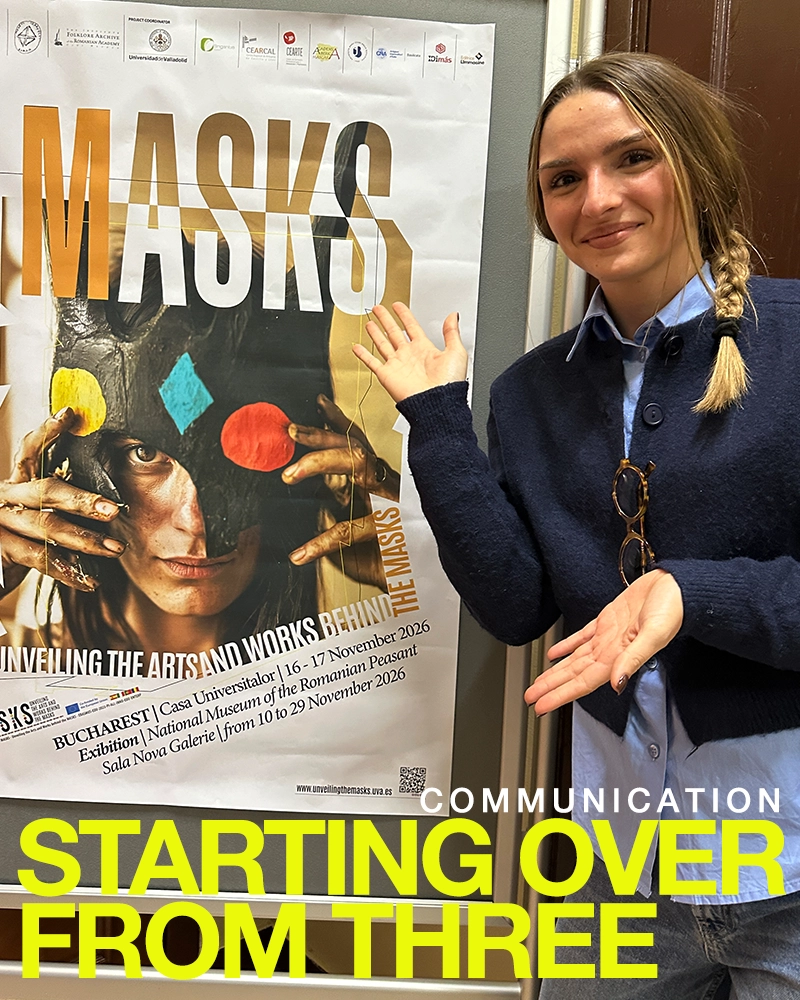
In the article preview photo, Marica Petruzzella

In the header photo, Georgiana Vlahbel


photo and design by Gaetano Armenio 


The closing of the European project MASKS in Bucharest, told by the person who looked after its communication

FOLLOW THE ...

29 October 2026

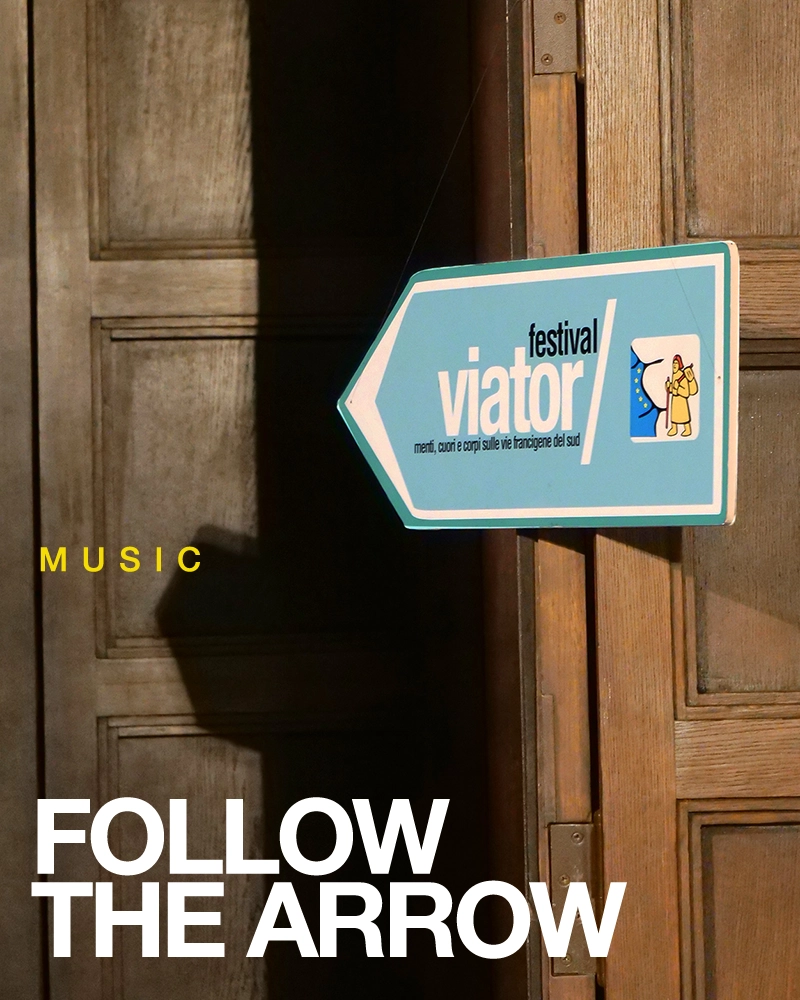
On 8 November, in Molfetta, Festival Viator opens with a title even altar boys know: In principio erat verbum. Two weeks later, on 21 November, in the abbey of Santa Maria La Sanità del Casale in Pisticci (MT), on the eve of Saint Cecilia, patron saint of musicians, the town band answers with another title: In principio era il suono, in the beginning was the sound.

Two different beginnings on the same programme. The theme of the 12th edition is LOGOS, and apparently it allows more than one answer.


Festival Viator, directed by Giovannangelo de Gennaro and Michele Lobaccaro, brings music to the Southern Via Francigena from 8 November to 20 December 2026, with concerts in Puglia, Lombardy, Basilicata and Sicily. I have followed it closely since 2021, and I told how it grew in the project page.


What LOGOS means

In Greek, logos means word, speech, reason, measure. The Gospel of John places it at the beginning of everything, and the festival’s subtitle says where this word has to reach: minds, hearts and bodies.

For anyone who walks, the first word you meet on the road is an arrow showing you the way.


In the programme Italian is not enough. There is Xenia, Greek for hospitality, Aion, time, and dhrupad, the sacred chant of India.


Sabir, the language of travellers

In Calvisano (BS), on 8 December, Stefano Saletti and Banda Ikona Trio present Sabir, il Logos del Mediterraneo. Sabir was the lingua franca of the ports, a mix of Italian, Spanish, Arabic and Greek that was nobody’s mother tongue and helped merchants understand each other. With no homeland and no official grammar, it lasted for centuries. In a port town like Molfetta, the idea doesn’t sound strange.


In Molfetta the word moves house every evening

Here the festival lives in the churches of San Bernardino, the Immacolata, Sant’Andrea and San Domenico, the Diocesan Museum and the Cittadella degli Artisti. On 14 November Ciro Montanari’s tabla meets Virginia Nicoli’s dhrupad singing. On the 29th, at Conterosso Social Club, Valeria Sturba and Vincenzo Vasi play Dada music on a theremin, an instrument you play without touching it, moving your hands through the air.


On 27 November the Cittadella screens Santiago by Yann Samuell and hosts a talk with people who accompany fragile teenagers along the walking routes.

The festival closes on 20 December with Brigan and a title that is neither word nor sound: Luna, cera e vino, moon, wax and wine.


Festival Viator 12th edition | LOGOS
Molfetta, 8 November to 20 December 2026, 8.30 pm
Churches of San Bernardino, Immacolata, Sant’Andrea, San Domenico | Diocesan Museum | Cittadella degli Artisti | Conterosso Social Club
Info: +39 340 619 0019 (WhatsApp only) | festivalviator.it


The 12th edition of Festival Viator across Puglia, Lombardy, Basilicata and Sicily, told by someone who has followed this music and walking festival closely since 2021

THERE'S ...

15 October 2026

I'm holding a guide to Molfetta that I laid out myself: I recognise the photos, the ten itineraries and, on the last pages, the names. Hotels, restaurants, tour guides from my town, people I know by name, and I even know where they have their morning coffee. This is VisitMolfetta, the tourism promotion project I built for Molfetta together with them.


From "there's nothing here" to ten itineraries

It all began with a line I heard at every meeting with the local tourism sector: "Why would a tourist stop here? There's nothing." The people saying it were the very ones who made a living from tourists.

I thought the opposite. Every town has its genius loci, it's just that the people who live there walk past it every morning and no longer see it. So I looked at Molfetta as if I hadn't been born there: the harbour, the Cathedral on the sea, the Easter processions, the September feast, the shipyards, the summer nights.


Out of that supposed nothing came ten itineraries, each with its own name and soul. I turned them into three tools: a pocket guide in Italian, English and German, a multilingual web portal, www.visitmolfetta.it, and a daily story on social media.


A guide nobody could pay for alone

My job, which others call tourism and cultural marketing, was to bring those two worlds to the same table. The Municipality put in a tiny share of the funding (no comment) and access to trade fairs inside the Apulia Region stand. The private businesses provided most of the budget and, above all, their faces: if a tourist came to Molfetta, the game would be played in their rooms and at their tables.


Winning them over one at a time

There was no decisive meeting. The sceptics weren't one or two to convince: they were all of them. I took them on one by one, always facing the same objection.

I'll confess something. Harder than the design, the copy and the translations was holding together people who, the day before, had been competing on the same street. A public-private network isn't signed. It's built one phone call at a time, and with every call you risk losing it.


Tourists buy a town, not a hotel

At a fair like Berlin, nobody stops for a single restaurant in a town they've never heard of. They stop for a destination. A single business can't offer one. A tourism sector that shows up united can.

That year, the tourism and cultural promotion project VisitMolfetta toured the most important national and international travel trade fairs: from the BIT in Milan to the ITB in Berlin and TTG in Rimini.


Tourism promotion for Molfetta and cultural tourism marketing: a public-private network, a multilingual guide, a web portal and international trade fairs

WHAT AM I ...

23 September 2026

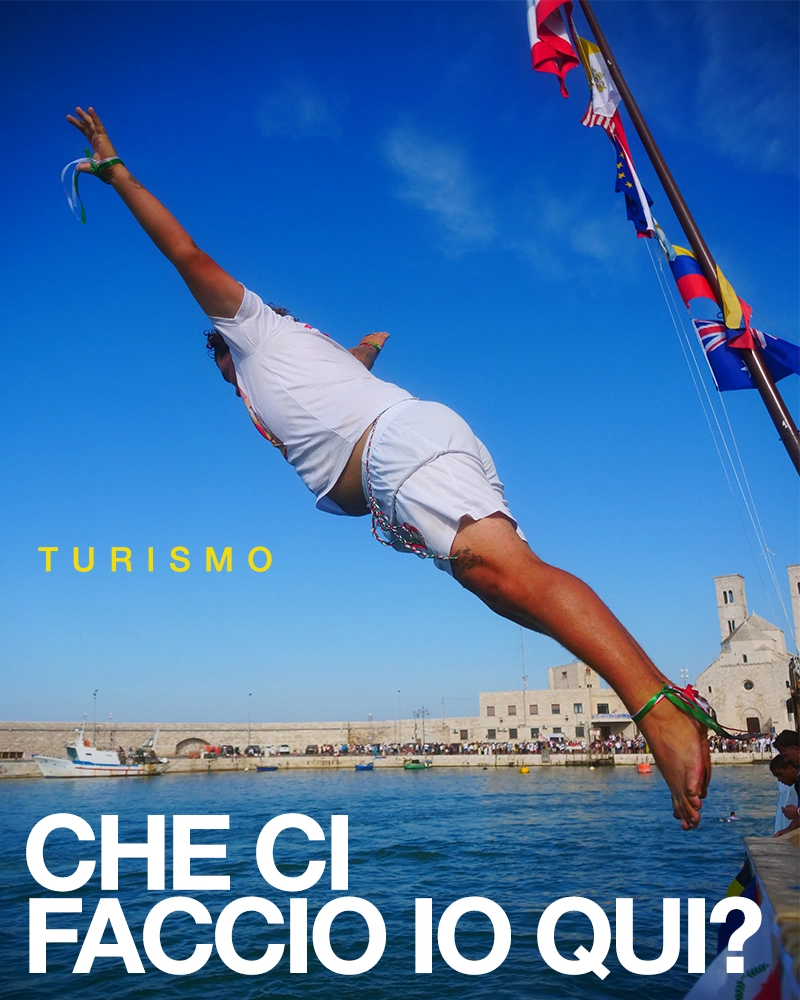
Four hours aboard the fishing boats for the sea procession of Molfetta, feast of Maria SS dei Martiri, patron saint of the town.

The sacred, the profane and a sign read backwards.


What am I doing here. Inside the sea procession of Molfetta

S"What am I doing here?" is a question I have asked myself many times, in my working life and outside it. It comes when you feel out of place, when your being somewhere has no obvious reason. And yet the urge to explore new ground always pushes me to try, because curiosity is an incurable disease.


Luckily, I would add.I had been invited by Mimmo Facchini, a friend and a former boat owner, for two reasons that hold together, because he thinks I am a capable photographer and because this year the draw had gone to his cousin's fishing boat, the Nuovo Saturno, given that in Molfetta who carries the statue out to sea is decided neither by money nor by family name but by a lottery, and when your turn comes it rarely comes again.


He asked me aboard for the sea procession of 8 September, the feast of Maria Santissima dei Martiri, four hours from four in the afternoon until eight in the evening with no way of getting off, and I accepted late and rather badly, out of curiosity more than courage.


The comfortable side of the barrier

I have worked on patron saint rites since 2006, with Settimana Santa in Puglia and then with Patroni di Puglia, and for years I have been building stories about popular devotion while always standing on the spectator's side, with the good spot, the light worked out in advance and the freedom to leave whenever I felt like it. I found myself surrounded by people I did not know, faces I had never seen before, and in Molfetta that does not happen, because I do not live in a big city and here you know everyone at least by sight. Not them. Not one.


On board that freedom does not exist, and this is what changes everything, because for the first two hours I did nothing but trip over everything and bang my head on hatches built for men shorter than me, while my only thought was not to end up in the water, which is to say that anthropology, seen from the inside, is done mostly with your knees.


What you cannot see from the shore

Then at some point I stopped defending myself and I looked, and there was an old man beating a bass drum standing on planks that moved, and a man diving in fully dressed while the cathedral slid past behind him, and a friar talking to the sailors and gesturing towards the harbour, and wedged between two boards of the deck a pale blue card with Ave Maria printed on it, fallen and trodden on, which nobody all afternoon could be bothered to pick up. People sang, danced and prayed.


And this is what you cannot grasp from the shore, because here the sacred and the profane do not take turns but live together in the same square metre of deck and in the same minute, so much so that on that afternoon Maria Santissima dei Martiri was travelling on the deck of a boat named after a Roman god, and nobody had noticed, myself first of all.


At eight I came down wrecked, with the feeling that I had spent fifteen years photographing the side the feast shows to outsiders.


photo by Gaetano Armenio


Four hours inside the sea procession of Molfetta, the feast of Maria Santissima dei Martiri, told by someone who has designed and photographed popular rites since 2006